


















- All FAQs
- About MiaDonna
- Online Ordering
- Warranty & Repair
- Pricing & Discounts
- Payments & Financing
- Shipping & Delivery
- Returns & Exchanges
- Diamond Education
- Gemstone Education
- Jewelry Education
- Care & Cleaning
- Ring Sizing FAQs
- International Orders
All FAQs
About MiaDonna
MiaDonna is the first retailer to offer exclusively lab grown diamonds and gemstones as a pioneer in the jewelry industry. The company was founded in 2005 with a simple and powerful idea: to reimagine diamonds for the
modern world through innovation, integrity, and impact. Our mission is to be with you through life's grand milestones and its quiet joys, with jewelry that brings beauty to every chapter of your story.
Visit our
About Us
page to learn more about our story and purpose.
Yes! Our flagship retail store is located at Bridgeport Village in Portland, Oregon. Stop in and enjoy a glass of wine or a beer while shopping. Our non-commissioned lab-grown diamond and fine jewelry experts are available to guide you
in your jewelry purchasing journey. Walk-ins are more than welcome! If you prefer to book a private appointment, visit our
Appointments Page.
Refreshments provided just for stopping in, including water, tea, espresso and coffee, wine, champagne, and a selection of local and international beer.
Our store location is:
7279 SW Bridgeport Rd
Portland, OR 97224
For more information, visit our
Flagship Store Page.
Yes! Our jewelry specialists are available for private appointments in our flagship store in Bridgeport Village in Portlan, Oregon. In the midst of your shopping appointment, enjoy an elegant lounge, where you can unwind and savor a selection
of decadent refreshments. Enjoy a glass of champagne or enjoy a perfectly brewed cup of artisanal tea, while browsing our technology, loose stones and fine jewelry with one of our expert jewelry specialists.
Private appointments are typically set for 60 minutes. Feel free to bring family and friends to your appointment.
To make a private appointment in our Bridgeport Village Flagship Store in Portland, Oregon visit our
Appointments Page.
Yes! Our jewelry specialists are available for one-on-one virtual video call appointments via Skype, Facetime, and Google Hangout. Appointments are schedule for 30 minutes at a time, and we will prepare jewelry styles to review during your appointment. Additionally, our jewelry specialists can co-shop with you on our website to find just the right piece. They can even send you a link for purchase when complete. Please note that while our jewelry specialists will be on camera, you are not required to do so. To schedule a virtual appointment, visit our Appointments Page.
To cancel or change your appointment, simply click on your appointment confirmation email, and you will be able to cancel or adjust your appointment.
While we'd love to have our entire collection of jewelry on display in our store, it simply wouldn't all fit since we offer thousands of variations of popular jewelry styles. However, our Portland Oregon store carries hundreds of our most popular styles to purchase right in the store. Additionally, our jewelry specialists are available to find just the right piece from our online assortment, or even to customize the piece of your dreams. If there is a particular style or diamond you’d like to see, please Contact Us or Book an Appointment and we'll be happy to help!
B Corp stands for Benefit Corporation. MiaDonna has been B Crop certified since 2019 and are proud to be the first B Corp Certified Lab Grown Diamond Company! As a certified B Corporation, we're committed to meeting the highest standards for social and environmental performance, public transparency, and legal accountability to balance profit and purpose.
Online Ordering
Yes! Shopping at MiaDonna is safe and secure. We do not store any credit card information. Instead, your payment information is transmitted to payment processors through Secure Socket Layering (SSL), which is the industry
standard encryption technology that ensures safe internet transmission of your personal information. Through SSL encryption, the certificate assures that information is kept private, and never stored on our servers.
Making a credit card purchase is just as safe on our website as by telephone, but if you prefer the latter, you may purchase online merchandise by calling 503-336-1581 during store hours.
One of our customer service associates will gladly assist you with your order.
If you realize that you made a mistake on your order, please
contact us
as soon as possible, and we will try to help. We may be able to adjust an engraving, or a ring size, but in certain circumstances, the only recourse may
be that we need to cancel the current order, and place a new one. Our jewelry specialists will guide you on the best course of action when you contact them.
If you realize you made a mistake on your order, please contact us as soon as possible at 503-336-1581 or email info@miadonna.com to discuss your options. Please have your order number ready.
At MiaDonna, we do not charge any additional fees for processing orders. No credit card processing fees, no re-stocking fees, no custom order fees (some restrictions apply). Your order total is the price of the merchandise, shipping costs (only if applicable), and state taxes (only if applicable). Please note that international orders may incur customs and duty fees not within our control. Please speak with a local customs representative within your country for further information on applicable customs and duty fees.
Warranty & Repair
We do not offer a warranty on your Diamond Hybrid®, Lab Created Gemstone and/or Lab Grown Diamond. However, we do offer a warranty on the setting itself in the case there is a manufacturing defect.
If there is any wear and tear then the setting will not be covered under warranty.
If there is any kind of manufacturing defect on one of our settings we will cover all the costs associated with the repair or remake and we will reimburse you for any shipping fees you incur. We are also happy to offer free cleaning services,
as well as free center/side stone tightening, with the only cost to you being shipping to and from our location. Other repairs, such as accenting stone replacement, resizing, polishing, prong repair, etc. usually have costs associated with them.
Pricing & Discounts
Sales: At MiaDonna, we don't run sales in our retail or online stores. We understand the importance of staying within your budget, and getting something you love. We do not believe in high markups or inflated prices, so that you have to wait for a
sale. Instead, we offer our best price every day for the jewelry you love. Please note, based on the fluctuating price of diamonds, gemstones, precious metals, and labor costs, our prices may change from time to time, but that is so that we can
continue to offer you the best price for the piece.
Discounts: While we do not run sale priced discounts, we do offer a few ways to save for select customers. New customers can receive a promo code to save on their first order by signing up for our Email & Text newsletter.
Additionally, we offer a 10% discount for military service members and first responders, once they verify with ID.me. Visit our
page to learn more.
Promotions: From time to time, we offer additional incentives to customers to make their purchase from MiaDonna, like a Free Gift with Purchase, which we promote on our home page, banners, and in My Bag.
To learn more about all of our active promotions and incentives, visit our
Specials & Promotions
page.
Yes! MiaDonna appreciates the sacrifices made by our dedicated US active-duty military personnel, National Guard members, reservists, veterans, retired personnel and spouses, and offers a 10% discount on their purchases.
Current or former police officers, firefighters, or EMT/paramedic personnel also receive a 10% discount on their purchases.
Visit our
Military and First Responder Discount
page to learn more.
United States: We collect sales tax from customers in states where we are required to do so, and we remit these taxes to the appropriate taxing authority in your state on your behalf. Please note that we make no profit on these taxes.
All sales taxes are calculated and clearly displayed at checkout. Since we are a retailer, we do not sell business-to-business (B2B), and we therefore do not offer tax exemptions on orders.
International: International orders require that duties and taxes be paid in the country to which they are shipping. While we do not charge a shipping fee for international orders, the customer is required to pay the duties
and taxes for the order to be delivered to the final address. In most cases, FedEx will arrange for you to pay the applicable duties and taxes, and will then deliver the package to the final address.
Payments & Financing
PAYMENT OPTIONS:
We offer a variety of secure and flexible payment options including all major credit cards, PayPal, Venmo, Apple Pay, Google Pay, Amazon Pay, and Bank wire transfers (for orders over $500).
FINANCING OPTIONS:
Affirm lets you split your purchase into 4 interest-free payments or monthly installments of up to 36 months. Checking your eligibility takes seconds and won't affect your credit score. Choose Affirm at checkout.
ShopPay Installments offers you the option to split your purchase into regular payments with options to pay in bi-weekly or monthly installments,
Click here
to see your rate and learn more about our financing option.
both online and in store. Installment options can be used on orders over $50 USD, including discounts, shipping, and taxes
Visit our
Payments & Financing
page for more information.
We offer two secure online financing services through our partners:
Affirm lets you split your purchase into 4 interest-free payments or monthly installments of up to 36 months. Terms apply. Choose Affirm at checkout.
ShopPay Installments offers you the option to split your purchase into regular payments with options to pay in bi-weekly or monthly installments, both online and in store.
Installment options can be used on orders over $50 USD, including discounts, shipping, and taxes. Choose Shop Pay at checkout.
Neither financing options perform a hard credit check and will not affect your credit.
Visit our
Payments & Financing
page for more information.
When your credit card declines your order at MiaDonna, it is most often due to security measures from your issuing bank. Please note that MiaDonna does not approve or decline your credit card payment. That is up to the issuing bank
of your credit or debit card.
Usually, the decline is for one of two main reasons. First, your purchase amount on MiaDonna may exceed the daily purchase limit for your card. Another reason for declines is often that your purchase from MiaDonna
may be outside of your normal spending patterns and amounts, which will sometimes cause your issuing bank to decline the order.
To resolve the issue, typically you need to just call your bank and let them know that you are trying to purchase online. Provide your bank with the amount of your purchase, tell them to expect an order from MiaDonna and Co., and
request they adjust the daily limit or release enough funds for the purchase. This usually allows the next purchase to go through.
Your credit card will be authorized immediately, but every order is verified manually. Upon verification, your funds will be captured. This process is usually completed within 48 hours.
Shipping & Delivery
MiaDonna offers FREE shipping for both domestic and international shipments through FedEx and DHL.
U.S Orders: MiaDonna offers FREE FedEx 2Day shipping for all orders shipped to a United States address. Expedited shipping options are available at checkout for a fee.
Please note that choosing an expedited shipping method will not speed up the time that it takes to process your order, make your jewelry, and prepare it for shipment.
International Orders: MiaDonna offers FREE DHL Express Worldwide service. Once shipped, the package may take two to five (2-5) days to arrive.
Please note that duties and taxes may be required by the customer to be paid prior to delivery, which can add additional time.
We require a signature for delivery of all orders.
Items are either Ready-to-Ship or Made-to-Order. See the product detail page for estimated ship dates.
To view our complete shipping policy details, visit our
Shipping Page
MiaDonna's jewelry is either Ready-to-Ship or Made-to-Order. Most items available online are Made-to-Order.
Ready-to-Ship items are in-stock and generally leave our facility within 1 to 4 business days (depending on ring sizing).
Made-to-Order pieces, which are created once you place your order, typically ship within three (3) weeks.
We display the Ship By date for your specific item throughout your shopping experience—on the product page, in your bag, at checkout, and on your final receipt.
If your purchase is time-sensitive, please check this date once you've finished customizing your piece.
We are committed to shipping all orders as quickly as possible and will not be able to accelerate the jewelry's processing or creation time. While we strive to ship most items on or before the Ship By date, rare delays may occur
due to rigorous quality control, material availability, or manufacturing capacity.
Delivery Service:
All completed U.S. orders are shipped free of charge via FedEx 2Day service. Faster shipping options are available for U.S. customers during checkout.
International orders are shipped via DHL Express Worldwide which offers a delivery window of 2-5 days.
To view our complete shipping policy details, visit our
Shipping Page.
We ship domestically to all 50 States in the U.S. via FREE FedEx 2 Day Delivery. Ship dates may vary by item. See the product detail page for Ship By dates. To view our complete shipping policy details, visit our Shipping Page.
We ship internationally to over 40 countries around the world via DHL Express Worldwide service, which is a two to five (2 to 5) day delivery service.
We commonly ship to Canada, UK, France, Germany, Switzerland, Italy, Australia, New Zealand and many others. Ship dates may vary by item. See the product detail page for Ship By dates.
All international shipments are subject to the laws set forth by your country's Customs Department. Please note that MiaDonna has no control over customs/taxes for individual countries.
If you are unsure how the customs process works in your country, please contact your Customs Department directly with any questions or concerns you may have about receiving your MiaDonna order.
To view our complete list of shipping destinations, as well as our full shipping policy details, visit our
Shipping Page.
MiaDonna offers FREE shipping for both domestic and international shipments through FedEx.
U.S Orders:
MiaDonna offers FREE FedEx 2Day shipping for all orders shipped to a United States address. Expedited shipping options are available at checkout for a fee.
Please note that choosing an expedited shipping method will not speed up the time that it takes to process your order, make your jewelry, and prepare if for shipment.
International Orders:
MiaDonna offers FREE DHL Express Worldwide service. Once shipped, the package may take two to five (2-5) days to arrive. Please note that duties and taxes
may be required by the customer to be paid prior to delivery, which can add additional time.
We require a signature for delivery of all orders.
Items are either Ready-to-Ship or Made-to-Order. See the product detail page for Ship By dates.
To view our complete shipping policy details, visit our
Shipping Page.
MiaDonna requires a signature at delivery for all orders. This protects both you and us against lost, missing, and stolen packages. FedEx/DHL will typically make three delivery attempts at your address over three consecutive days, except for Sundays.
After that, if no one has signed for the package, FedEx/DHL will send the package back to us, and we will contact you to arrange an alternate delivery.
To view our complete shipping policy details, visit our
Shipping Page.
Yes, we can provide overnight shipping to most US destinations for an additional charge. However, most of our jewelry is made-to-order, so overnight shipping will take place after the 10-15 business days of crafting time.
Ready-To-Ship jewelry pieces can be shipped overnight for an additional charge.
To view our complete shipping policy details, visit our
Shipping Page.
MiaDonna requires a signature at delivery for all orders. This protects both you and us against lost or stolen packages. FedEx and DHL typically make three delivery attempts on consecutive days, excluding Sundays.
If no one has signed for the package after the third attempt, FedEx or DHL will return it to us and we'll contact you to arrange an alternate delivery.
To view our complete shipping policy details, visit our
Shipping Page.
Yes, you can ship your order to a different address than your billing addresss. Simply input the shipping address that you would like the order to go to in the Shipping Address at checkout. The address must be a physical home or business address.
We are unable to deliver to Post Office Box (PO Box) addresses. Please note that different Ship To addresses than the Bill To address may cuase alerts for our fraud prevention team.
As such, we may need to contact you to confirm the alternate address over the phone for security purposes.
To view our complete shipping policy details, visit our
Shipping Page.
Yes, you will receive a tracking number via email once your jewelry order is processed, the jewelry made (when applicable), and the package is prepared for shipment. This will allow you to track your package and anticipate its arrival.
Please note that all items are either Ready-to-Ship or Made-to-Order. Ready-to-Ship items typically ship within one to four (1 to 4) business days (depending on ring sizing), while Made-to-Order items typically ship within 3 weeks.
See the product detail page for Ship By dates.
To view our complete shipping policy details, visit our
Shipping Page.
We cannot typically expedite the time that it takes to process and create your jewelry. Please note that all items are either Ready-to-Ship or Made-to-Order. Ready-to-Ship items typically ship within one to four (1 to 4) business days
(depending on ring sizing), while Made-to-Order items typically ship within 3 weeks. See the product detail page for Ship By dates.
Please contact one of our jewelry specialists if you wish to request an expedited order. They will work with our production team to try to meet your request, but they are not able to promise an earlier ship date.
It is important when crafting your jewelry that we do not rush the order so as to compromise on the quality of your piece. Our production team will make every attempt to rush your order without compromising quality.
Please order within the Ship By date on the product detail page to ensure that you receive your piece in time.
To view our complete shipping policy details, visit our
Shipping Page.
At MiaDonna, we pride ourselves on providing a unique shopping experience, from the moment you're introduced to our brand to the first time you put on your jewelry.
Your jewelry will be delivered to you with the following items included:
- Gift Bag
- Stylish jewelry box
- Non-toxic jewelry cleaner (polishing cloths for international guests)
- Certified grading certificate (if applicable)
- Copy of your order receipt and welcome information
Returns & Exchanges
MiaDonna is proud to offer a FREE 60-day return policy from the date of original shipment, with FREE return shipping via FedEx. Additionally, we do not charge any re-stocking fees.
Fees for missing diamond certificates and missing gifts with purchase will apply.
• All jewelry and loose stones, including engraved items, are eligible for return within 60 days
• All Ready-to-Ship and Made-to-Order items, including engraved items, will be refunded to the original form of payment
• Custom jewelry and special orders will be refunded to store credit only
To be eligible for return:
• Items must be received within the 60-day return window from when the item originally shipped
• Jewelry must be in its original, undamaged, and unworn condition with the return policy tag attached (no tampering).
• Returns must include the lab grown diamond certificate (where applicable). A $50 replacement fee will apply for each missing certificate.
• Free gift with purchase (where applicable) must be included with the qualifying item(s). The retail value of the free gift will be withheld from refund if not included.
Additional terms and conditions may apply. To view our complete return policy details, visit our
Returns Page.
To initiate a return, simply log into your
account
and submit a return request through our self-service returns portal.
You’ll need the email address used for the original purchase. Once approved, you’ll receive a return authorization
and a pre-paid return shipping label, which must be used within 7 days, along with detailed return instructions.
Prefer assistance? You may also contact us at
help@miadonna.com
or through our
Contact Us
page.
To view our complete return policy details, visit our
Returns Page.
At MiaDonna, ALL of our jewelry is eligible for return within our 60-day return window, including engraved items. All jewelry may returned for refund to the original payment method, except for
Custom Jewelry and Special Orders, which are refundable for store credit only.
Additional terms and conditions may apply. To view our complete return policy details, visit our
Returns Page.
Yes! We're happy to let you know that all of our jewelry items, including Custom Jewelry and Special orders are eligible for return within our 60-day return policy.
However, Custom Jewelry and Special Orders are eligible for refund to store credit only. Store credit may be used on a subsequent purchase from MiaDonna.
Additional terms and conditions may apply. To view our complete return policy details, visit our
Returns Page.
Yes! At MiaDonna, we are proud to offer free returns within our our 60-day return policy for all items, including engraved items.
Additional terms and conditions may apply. To view our complete return policy details, visit our
Returns Page.
Once youre return is received, our quality assurance team will inspect and verify the condition of the returned item(s). Usually within three business days of receiving your order, our team will issue the refund. Your bank will typically refund your original form of payment within 2-10 business days, and this timeline may vary depending on your bank's processing policies. For credit card refunds, please allow up to one monthly billing cycle for the credit to appear on your statement.
At MiaDonna, our international return policy is the same as our domestic return policy with a few exceptions. The international return policy is FREE returns within 60-days from when your order ships.
All jewelry must be in its original, undamaged, and unworn condition, and must include all certificates. Custom Jewelry and Special Orders are refundable for store credit only.
Please note that additional forms are required to return your item back into the United States, including the Foreign Shipper's Declaration for Returned Goods, three copies of the FedEx Airway Bill, and three copies of the Export Commercial Invoice.
Missing, incomplete, or unsigned documents may delay your refund and could result in duties and taxes being deducted from the total refund amount.
Additional terms and conditions may apply. To view our complete international return policy details, visit our
If you are purchasing finished jewelry, we do not allow multiple pieces to be purchased for comparison with the intent to keep one and return the others since each piece will be made-to-order.
However, we have an excellent team of Jewelry Specialists who will happily assist you in making a decision from our selection.
Please do not hesitate to contact us before your purchase so we can answer any of your questions and help you find the perfect setting. If we suspect that an order is comparative, it may be blocked from shipping or returning.
Additional terms and conditions may apply. To view our complete return policy details, visit our
Returns Page.
Diamond Education
Yes. Lab grown diamonds, also known as lab created diamonds, are real diamonds. They have the same physical, chemical, and optical properties as natural, or earth-mined, diamonds. The only difference is
that they are made in a controlled laboratory setting instead of the earth's crust. Both lab grown diamonds and natural diamonds are made of pure carbon crystals and have the same hardness and durability.
The properties of lab grown diamonds - including cut, color, clarity, and color - are measured and graded the exact same way as mined diamonds.
To learn more about lab grown diamonds, visit our
Lab Grown Diamond Guide.
The 4 C's of diamonds are: Cut, Color, Clarity, and Carat. Diamond prices are heavily impacted by these four characteristics, and most diamonds are independently graded according to standards set by the Gemological Institute of America (GIA) in 1953.
It is the universal language for diamond quality, ensuring consistency and accuracy around the world.
To learn more, visit our
4C's of Diamonds page.
Lab grown diamonds are made one of two ways— either through High-Pressure High-Temperature (HPHT), or through Chemical Vapor Deposition (CVD). The HPHT method subjects a diamond "seed" to extreme heat and pressure, a process which mimics natural
diamond formation in the earth. In the CVD method, a diamond "seed" is heated to high temperatures in a carbon-rich gas chamber, where the gases break down into plasma and carbon atoms form on the original seed.
Both methods produce beautiful lab grown diamonds which are, in fact, real diamonds.
To learn more about lab grown diamonds, visit our
Lab Grown Diamond Guide.
Yes. You can purchase a lab grown diamond without a setting.
To find the perfect diamond for you, visit our Shop
Lab Grown Diamonds Page.
Lab created diamonds can take a few weeks to several months to grow, depending on the size and quality of the diamond as well as the method used to grow them.
Larger stones requiring higher quality, like color and clarity, may require a more controlled, slower growth, which can extend the timeline.
Additionally, after the stone is grown, artisans still must cut and polish the diamond the same way that a mined diamond is cut and polished, which adds several days to weeks to complete before the diamond is ready to be set in jewelry.
To learn more about lab grown diamonds, visit our
MiaDonna's lab grown diamonds are ethically sourced through a global supply chain of highly reputable labs. As the first retailer to offer only lab grown diamonds, we have long standing relationships with a number of hand-selected suppliers in order to maintain our quality and craftsmanship standards.
Yes. MiaDonna's lab grown diamonds are ethically sourced from a global supply chain of highly reputable labs. We ensure that the labs we work with adhere to all industry best-practices, are 100% conflict-free, follow all local labor laws, and are do not fund war, violence, corrupt governments, or other human rights abuses.
The scientific meaning of "hardness" in gemology is the ability to resist scratching. The Mohs Hardness Scale ranks minerals from 1 (softest) to 10 (hardest) based on their ability to scratch one another.
A diamond's rank is 10 on the Moh's Hardness scale, making it the hardest of all minerals.
Hardness should not be confused with toughness. While a diamond is hard, in that it resists scratching from all other materials, it does not make them unbreakable.
Diamonds have a moderate level of toughness and a cleavage plane, which means they can crack, chip, or shatter if struck with enough force at the right angle. As such, you should always use care with your diamond jewelry.
A diamond certificate, also known as a diamond grading report, is a document issued by an independent gemological laboratory. It provides an assessment of a diamond's 4 C's and other characteristics, ensuring transparency
and aiding in value determination.
At MiaDonna all of our graded diamonds come with a complimentary diamond grading report from the International Gemological Institute (IGI) or the Gemological Institute of America (GIA).
While GIA set the standards for grading diamonds decades ago, IGI is the largest provider of lab grown diamond grading reports, and is considered to be the standard for grading lab created diamonds.
At MiaDonna, we provide grading certificates for all loose diamonds that we sell, whether set into an engagement ring or sold separately. Additionally, we provide grading certificates for all jewelry that includes a center stone (or matched pairs)
of one (1) carat or larger for solitaire stud earrings, and solitaire pendants, as well as certain other earrings and pendants. Our product detail page specifies if a product will come with a grading certificate.
While all their jewelry, including wedding bands, anniversary bands, eternity bands, earrings, bracelets, and necklaces do not include a grading certificate, our expert diamond team will ensure that the diamonds in the piece
are matched and meet the minimum advertised quality of the piece using GIA standards.
No, the grading reports are for your peace of mind. They independently verify the technologies being used, as well as the quality of the lab grown diamond you are receiving. Please use your purchase receipt from MiaDonna for insurance purposes.
While all of the 4 Cs are important, it is generally recommended to prioritize diamond cut quality over carat weight (size), as the cut has the most significant impact on a diamond's brilliance and sparkle. The choice between clarity (flawlessness) and color (colorlessness) is more a matter of personal preference and budget. Becuase lab grown diamonds are grown in a controlled environment, more diamonds are often available and very affordable in high color and clarity grades. This leaves room to focus on getting a high quality diamond that is also larger in carat weight.
Gemstone Education
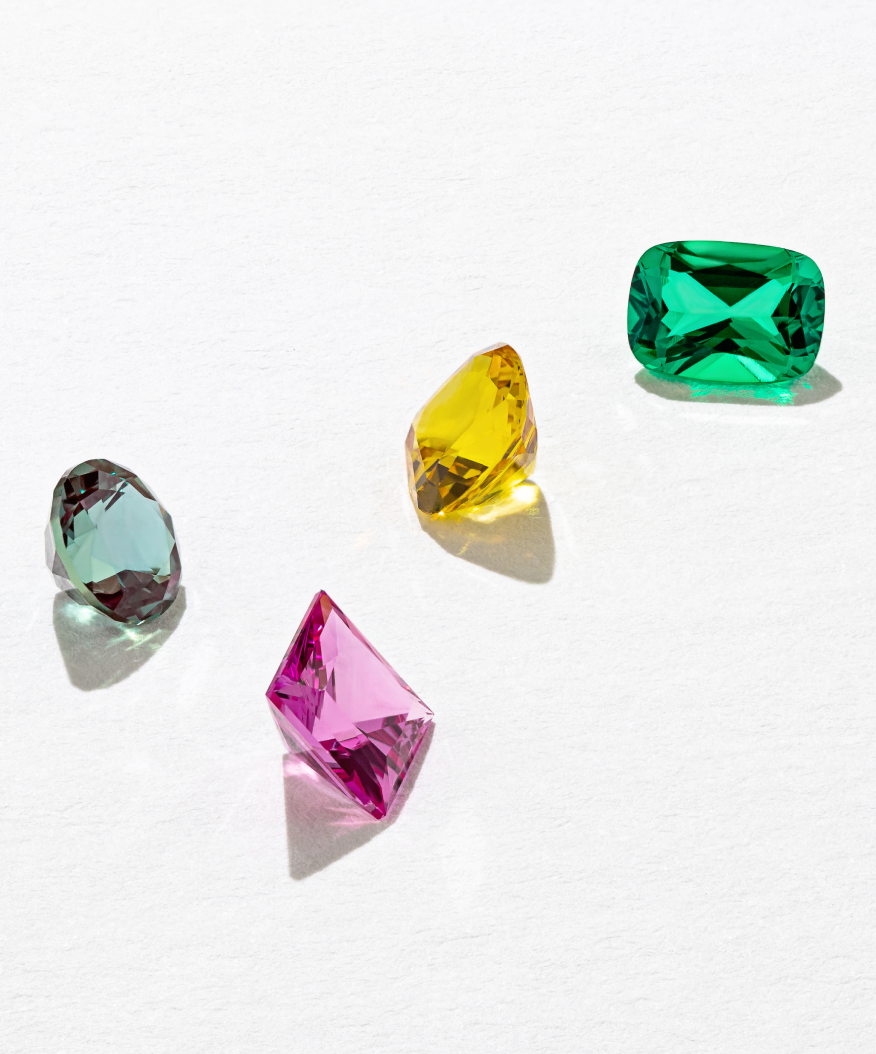
Just like lab-grown diamonds, lab created gemstones are real gems that possess the same chemical and physical properties as their natural counterparts. They are created in a laboratory using advanced techniques that mimic the natural gem formation process, resulting in gemstones with exceptional clarity and color.
Yes, lab-created gemstones are real gemstones. While they are not mined from the Earth, they have the same chemical composition and optical characteristics as natural gemstones. Lab-created gemstones offer an ethical and affordable alternative to mined gemstones.
Lab-created gemstones have several advantages. First, their production doesn't require mining. They also offer greater affordability compared to natural gemstones of similar quality. Additionally, lab-created gemstones are often free from the ethical concerns associated with the mining industry.
Lab-created and natural gemstones are comparable in quality, with both having the same chemical, physical, and optical properties. However, lab-created gems often have superior clarity and fewer imperfections due to controlled growing conditions, while natural gems are unique due to their natural, though sometimes less perfect, inclusions.
It can be difficult to distinguish lab created gemstones from natural gemstones, as lab-created gemstones can be chemically and physically identical to natural ones, and often only with the help of specialized equipment and expertise. Gemologists can distinguish them by using tests that look for specific inclusions (or lack thereof), internal characteristics, and trace elements that differ due to the growth process. Common visible differences include a higher degree of perfection and fewer inclusions in lab-created stones compared to their natural counterparts.
Lab created gemstones are generally more affordable than their natural counterparts of similar quality. However, their value is subjective and can vary depending on factors such as rarity, demand, and market trends. Lab created gemstones can offer excellent value for those seeking beautiful gemstones at a more accessible price point.
Absolutely! Lab grown gemstones are popular choices for engagement rings and other fine jewelry pieces. They offer a stunning and affordable alternative to natural gemstones, allowing individuals to create personalized and ethically sourced jewelry.
Lab created gemstones are chemically identical to their natural counterparts, whereas simulants are gemstone imitations that may have a different chemical composition. Simulants, such as cubic zirconia or moissanite, mimic the appearance of specific gemstones but have different properties.
Jewelry Education
At MiaDonna, we provide grading certificates for all loose diamonds that we sell, whether set into an engagement ring or sold separately. Additionally, we provide grading certificates for all jewelry that includes a center stone
(or matched pairs) of one (1) carat or larger for solitaire stud earrings, and solitaire pendants, as well as certain other earrings and pendants. Our product detail page specifies if a product will come with a grading certificate.
While all their jewelry, including wedding bands, anniversary bands, eternity bands, earrings, bracelets, and necklaces do not include a grading certificate, our expert diamond team will ensure that the diamonds
in the piece are matched and meet the minimum advertised quality of the piece using GIA standards.
At MiaDonna, we use 95% recycled metals to make our jewelry:
We offer nearly all items in 14K White, Yellow, or Rose Gold.
Select items are additionally available in 18K White, Yellow, or Rose Gold, and/or Platinum.
Select items are offered only in Sterling Silver.
To learn more about which metal choice is right for you, visit our
Metal Guide.
If you would like to special order one of our pieces that is not available in our store, visit our
Custom Jewelry & Special Order
page for more information.
MiaDonna is proud to accommodate Custom Jewelry & Special Orders. Our expert team can handle both types of requests.
Custom Jewelry
Custom Jewelry is exactly what it sounds like: truly unique pieces that are not offered in our stores. Whether you've seen something you like or have been dreaming up the perfect piece,
our team will design and create jewelry to your unique specifications.
Special Orders
Special Orders are modifications to items we offer in our stores. Whether you want a different gem type, carat weight, or metal type, we can likely accommodate your request as a Special Order.
Terms & Conditions
While we do not charge any additional fees for Custom Jewelry & Special Orders, including professional jewelry design, CAD drawings, and product rendering, we do require a $100 deposit to begin working on your request.
Your $100 fee will be applied toward the purchase of your Custom Jewelry. Additionally, we do require a $1,000 minimum purchase for items purchased through our Custom Jewelry & Special Orders Program.
All Custom Jewelry & Special Orders purchases are returnable for store credit only within 60 days from the date of purchase. Other terms apply.
For more details, visit our
Custom Jewelry & Special Orders
page.
To Get Started
Submit your request through our
Custom Jewelry & Special Orders
Page.
Book an Appointment
with one of our jewelry specialists.
Contact Us
to speak to a jewelry specialist by phone, email, or live chat.
At MiaDonna, we do not offer settings, also known as semi-mounts, without a center diamond. We only offer complete jewelry pieces for sale in our collection.
At MiaDonna, we sell completed fine jewelry pieces. We do not set stones from other retailers in our jewelry settings.
Care & Cleaning
The best way to clean your MiaDonna jewelry is with the jewelry cleaner included with your purchase. Allow your jewelry to soak in the solution for a few minutes to dissolve the grease from body oils, which play a large part
in trapping dirt onto your jewelry, especially rings. Use the enclosed brush to gently clean the jewelry to break-up trapped dirt. Be sure to get the underside of your stone with the brush if possible -
build up on the underside of gems can makes them appear dull. Rinse in clean water and pat dry. If you need more jewelry cleaner, you can purchase it
here.
Additionally, you can clean your jewelry with warm soap and water, gently scrubbing with a soft toothbrush. Rinse it clean and pat it dry.
If you would like your jewelry professionally cleaned,
Contact Us
, and we will assist.
For more information, visit our
Jewelry Care & Cleaning
page.
To care for diamond jewelry, avoid exposing it to harsh chemicals, such as household cleaners, hairspray, perfumes, and makeup. Store your jewelry separately to prevent scratches.
Regularly clean your diamond jewelry using a mild solution of warm water and mild soap, gently brushing it with a soft toothbrush.
For more information, visit our
Jewelry Care & Cleaning page.
Lab-created gemstones can be cared for similarly to natural gemstones. Clean them with mild soap and warm water, and avoid exposing them to harsh chemicals or high temperatures. It's also advisable to store them separately to prevent scratches.
For more information, visit our
Jewelry Care & Cleaning page.
Unfortunately, all precious metals aren't completely scratch resistant. Rings are especially susceptible to damage as they endure all of the wear and tear our hands do.
The everyday abrasions of clothing, sheets, towels, seatbelts, etc., can all contribute to wearing away the metal in our jewelry. Handling materials such as hard leather, wood, and plastic can also contribute to superficial scuff marks on the
surface of a ring. It is recommended that you remove your fine jewelry when doing physical work or tasks.
For more information, visit our
Jewelry Care & Cleaning
page.
The safest way to check if a stone is loose in the setting is to hold the ring by the base of the band close to your ear and gently tap it. If you hear a rattling noise then your stone is loose and needs to be sent in for tightening.
Please note: Some fancy shapes like a square princess cut should be set a little loose so not to put too much pressure on the stone's corners.
If your jewelry needs to be repaired,
Contact Us.
For more information, visit our
Jewelry Care & Cleaning
page.
Ring Sizing FAQs
We offer several ways to find the correct ring size:
Purchase
our plastic ring sizer.
Download
our printable ring size PDF.
International customers, view our
international ring size converter.
If the ring is a surprise, and you don't want them to know you're shopping for a ring for them, visit our
Ring Size Guide
for more tips to find their ring size. You can also learn about our resizing policy, plus some tips for measuring your finger for the correct size.
No worries! We offer a complimentary ring-resize within 90 days of when your order ships, including free shipping. We want your ring to fit perfectly, so we offer this service one time at no cost to you. Additional terms may apply.
Visit our
Ring Size Guide
for more details, including our full Ring Re-Sizing Policy.
We make our rings in U.S. sizes in 1⁄4 size increments (for example, 6, 6.25, 6.50, 6.75, etc.). Our standard women's ring sizes are 3-10, and our standard men's ring sizes are 6-13. The most popular ring size for women is size 6 in the U.S., and the most popular size for men is size 10 in the U.S. If your ring sizes fall outside of our standard sizes, please Contact Us to create a ring in your size.
International Orders
We ship internationally to the following countries (subject to change):
- Australia, Austria
- Bahamas, Bahrain, Barbados, Belgium, Bermuda, Bonaire
- Canada, Cayman Islands, China, Curacao, Cyprus
- Denmark
- Faroe Islands, Finland, France
- Germany, Gibraltar, Greenland, Guam
- Hong Kong
- Ireland, Italy
- Jamaica, Japan
- Macau, Malaysia, Marshall Islands, Montserrat
- Netherlands, New Zealand, Norway
- Portugal, Puerto Rico
- Qatar
- Singapore, Spain, Sweden, Switzerland
- Taiwan, Trinidad and Tobago, Turks and Caicos Islands
- US Virgin Islands, United Kingdom
International Duty, Customs & Tax
All international shipments are subject to the laws set forth by your country's Customs Department. The recipient is responsible for paying duties, customs fees, and/or local taxes that may be applied at the time of entry into your country.
If you have questions about the customs process, please contact your Customs Department directly.
For more details about shipping, including our full Shipping Policies and product lead times, visit our
Shipping Page.
MiaDonna is proud to offer FREE International Shipping via FedEx International Economy service, a 2-5 day delivery method. Once your order processed and your jewelry is completed (usually a 2-3 week process unless the item is Ready to Ship),
your order will ship at no additional cost to you.
International Duty, Customs & Tax
All international shipments are subject to the laws set forth by your country's Customs Department. The recipient is responsible for paying duties, customs fees, and/or local taxes that may be applied at the time of entry into your country.
If you have questions about the customs process, please contact your Customs Department directly.
For more details about shipping, including our full Shipping Policies and product lead times, visit our
Shipping Page.
International Duty, Customs & Tax
All international shipments are subject to the laws set forth by your country's Customs Department. The recipient is responsible for paying duties, customs fees, and/or local taxes that may be applied
at the time of entry into your country. If you have questions about the customs process, please contact your Customs Department directly.
For more details about shipping, including our full Shipping Policies and product lead times, visit our
Shipping Page.
International customers, view our
international ring size converter
to find the correct size to order.
Visit our
Ring Size Guide
for more details, including our full Ring Re-Sizing Policy.
Yes! MiaDonna offers free returns for international shipments. To return an item, simply Contact Us, and we will send you a return authorization code and a pre-paid FedEx return shipping label.
You are must include all required forms for return including the Foreign Shipper’s Declaration for Returned Goods, three copies of the FedEx Airway Bill, and three copies of the Export Commercial Invoice.
Other terms and conditions may apply. Visit our
Returns Page
for complete details.
<div class="dynamic-checkout__content" id="dynamic-checkout-cart" data-shopify="dynamic-checkout-cart"> <shopify-accelerated-checkout-cart wallet-configs="[{"supports_subs":true,"supports_def_opts":false,"name":"shop_pay","wallet_params":{"shopId":11644258,"merchantName":"MiaDonna","personalized":true}},{"supports_subs":false,"supports_def_opts":false,"name":"amazon_pay","wallet_params":{"checkoutLanguage":"en_US","ledgerCurrency":"USD","placement":"Cart","sandbox":false,"merchantId":"A3BQAGRLR11F3M","productType":"PayAndShip","design":"C0002"}},{"supports_subs":true,"supports_def_opts":false,"name":"paypal","wallet_params":{"shopId":11644258,"countryCode":"US","merchantName":"MiaDonna","phoneRequired":false,"companyRequired":false,"shippingType":"shipping","shopifyPaymentsEnabled":true,"hasManagedSellingPlanState":false,"requiresBillingAgreement":false,"merchantId":"M6M9J47C47X24","sdkUrl":"https://www.paypal.com/sdk/js?components=buttons\u0026commit=false\u0026currency=USD\u0026locale=en_US\u0026client-id=AbasDhzlU0HbpiStJiN1KRJ_cNJJ7xYBip7JJoMO0GQpLi8ePNgdbLXkC7_KMeyTg8tnAKW4WKrh9qmf\u0026merchant-id=M6M9J47C47X24\u0026intent=authorize"}}]" access-token="4fc8561c8fa34564717a211ecb94441b" buyer-country="US" buyer-locale="en" buyer-currency="USD" shop-id="11644258" cart-id="bb3f0edd6e926cc0d206976dc949893e" enabled-flags="["98c6d7e1"]" > <div class="wallet-button-wrapper"> <ul class='wallet-cart-grid wallet-cart-grid--skeleton' role="list" data-shopify-buttoncontainer="true"> <li data-testid='grid-cell' class='wallet-cart-button-container'><div class='wallet-cart-button wallet-cart-button__skeleton' role='button' disabled aria-hidden='true'> </div></li><li data-testid='grid-cell' class='wallet-cart-button-container'><div class='wallet-cart-button wallet-cart-button__skeleton' role='button' disabled aria-hidden='true'> </div></li><li data-testid='grid-cell' class='wallet-cart-button-container'><div class='wallet-cart-button wallet-cart-button__skeleton' role='button' disabled aria-hidden='true'> </div></li> </ul> </div> </shopify-accelerated-checkout-cart> </div>

