


















Diamond Shapes
Diamond shapes and diamond cuts are often used interchangeably, but they describe two different things. Shape refers to a diamond's outline and silhouette when viewed from above – round, square, pear, and so on. Cut, by contrast, refers to how precisely a diamond's facets are proportioned, symmetrical, and polished to return light, graded on a scale from Poor to Excellent or Ideal. A diamond can be round in shape and receive a Very Good cut grade, or oval in shape with facets cut slightly off – the two properties aren't the same thing, even though many shape names include the word "cut" (princess cut, emerald cut, and so on).
One nuance worth knowing: only the round brilliant receives a formal, overall Cut grade from grading labs like IGI, the leading laboratory for full 4Cs certification on lab-grown diamonds today. Fancy shapes – anything that isn't round – are evaluated for symmetry and polish instead, since there's no single industry-wide standard for "ideal" proportions across shapes as different as marquise and cushion.
Your partner may not know exactly which engagement ring they want, but there's a good chance they already have a shape in mind. The right choice often comes down to personal style, hand shape, and how the stone will be set, some shapes maximize sparkle, others prioritize a bigger look per carat, and others lean vintage or architectural. Here's what to know about each one.
Round Brilliant:
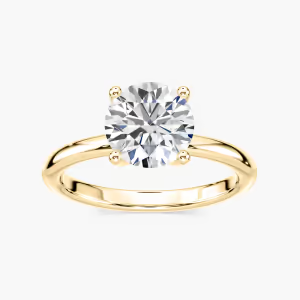
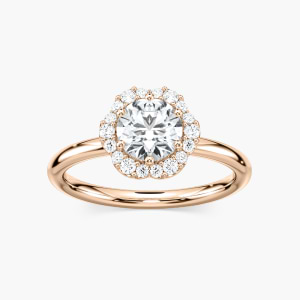
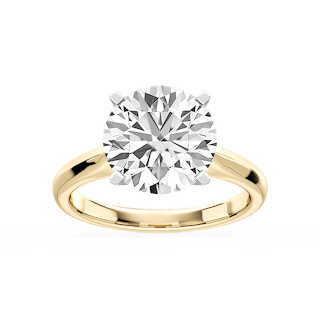
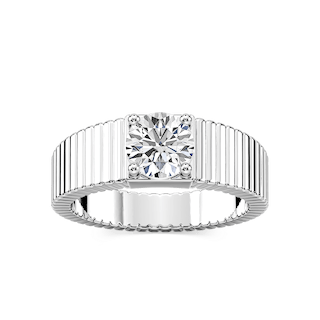
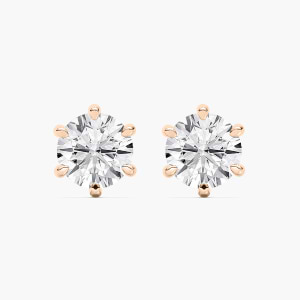
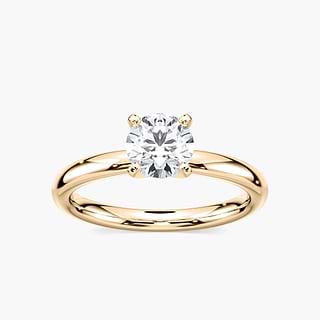
The round brilliant is the most researched, most refined, and still the most popular diamond shape on the market. Its modern form dates back to 1919, when mathematician Marcel Tolkowsky calculated the facet angles that return the maximum amount of light back to the eye, and diamond cutters have been using a version of his formula ever since.
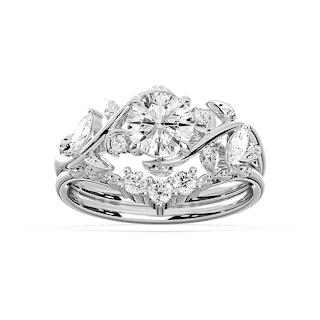
With 58 facets arranged in perfect radial symmetry, the round brilliant produces the most fire and scintillation of any shape, which is also why it's the only shape that earns an official overall Cut grade on a grading report. Because it scatters light so effectively, a round brilliant also does a better job of masking small inclusions and faint color than most fancy shapes, which is useful if you'd rather put your budget toward carat weight than a top clarity or color grade. Its symmetrical outline pairs with virtually every setting style, from a simple solitaire to a vintage-inspired halo.
Shop round cut engagement rings
Oval:
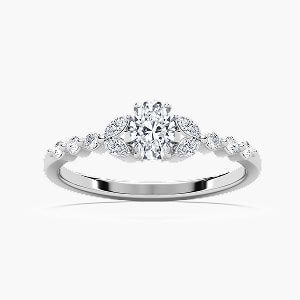
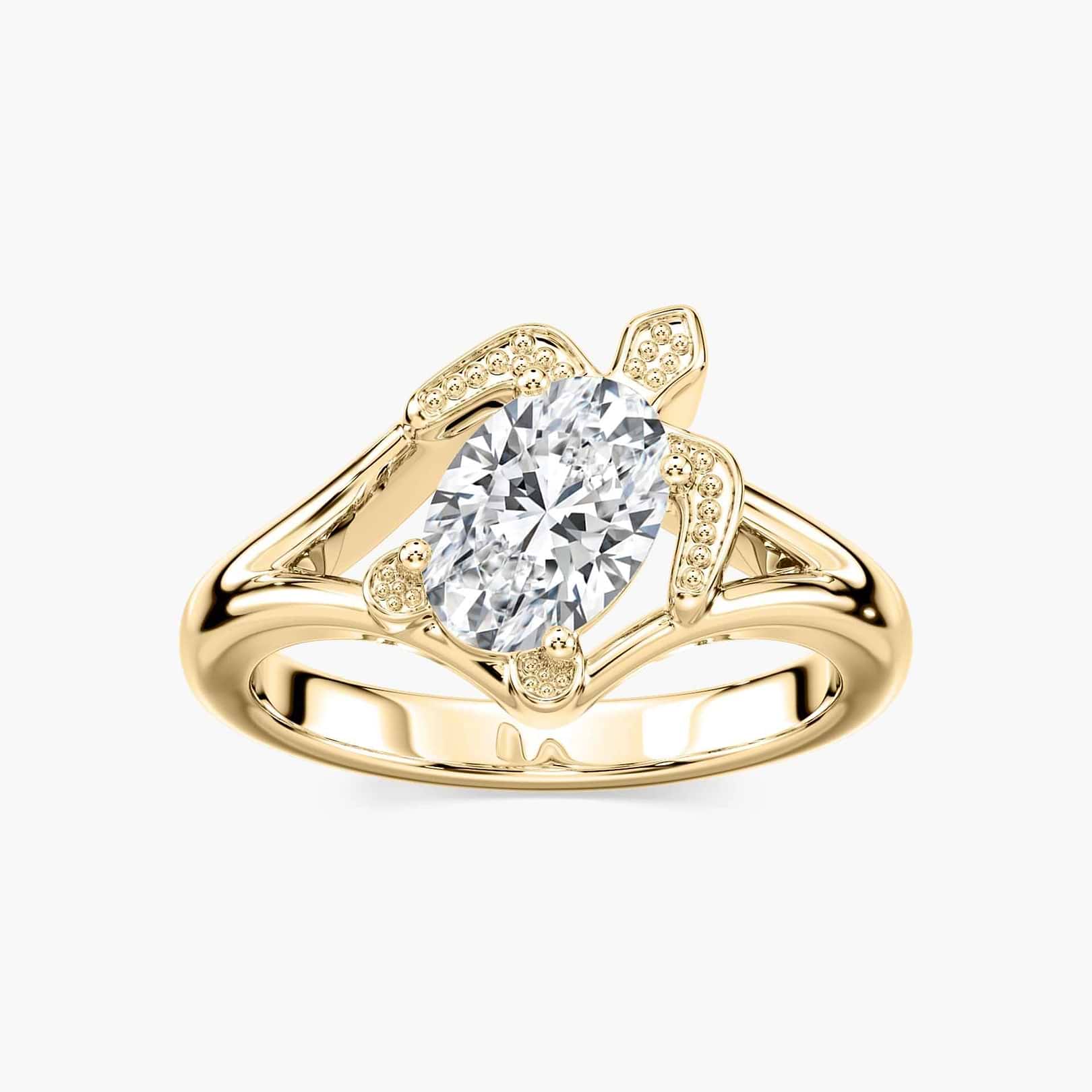
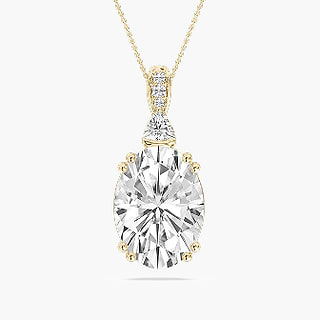
An oval diamond is essentially an elongated round brilliant, with a similar facet arrangement (around 56 facets) that carries over most of the round's brilliance. Because the elongated shape maximizes visible top-down surface area, an oval diamond tends to look larger than a round diamond of the same carat weight, and its shape can make fingers appear longer and slimmer. Traditional length-to-width ratios run from about 1.33 to 1.66, with more elongated ratios reading more dramatic.
One thing to watch for: ovals, along with marquise and pear shapes, can develop a "bow-tie," a dark, bowtie-shaped shadow across the center of the stone caused by light escaping through poorly proportioned facets rather than reflecting back to the eye. A well-cut stone minimizes this effect, so it's worth viewing an oval diamond in person, or in a detailed video, before committing.
Shop oval cut engagement rings
Emerald:
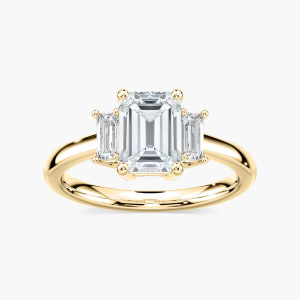
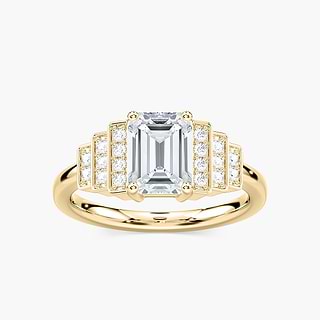
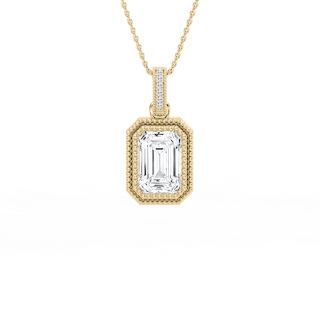
The emerald cut is a step cut, long parallel facets running in rows rather than the triangular facets of a brilliant cut, set into a rectangular outline with blocked (cut) corners. The traditional length-to-width ratio is about 1.5:1. When cut into a square outline instead, it's referred to as a square emerald, which can look similar to an Asscher.
Instead of the scattered sparkle of a brilliant cut, an emerald cut produces broad, architectural flashes of light, sometimes called a "hall of mirrors" effect. Because its open facets act almost like a window into the stone, inclusions and color are more visible in an emerald cut than in a round or cushion of the same grade, so it's worth prioritizing a higher clarity grade (VS1 or better) for this shape specifically.
Shop emerald cut engagement rings
Cushion:
The cushion cut has a square or rectangular outline with softly rounded corners, faceted (typically around 58 facets) to resemble a pillow, hence the name. It's the most direct descendant of the "Old Mine Cut," the cushion-shaped antique style that predates modern round brilliant faceting by more than a century, which is part of why the cushion cut reads as romantic and vintage even in a contemporary setting.
Rather than the round brilliant's crisp pinpoint sparkle, a cushion cut produces broader, softer flashes of light, sometimes described as a "candlelight" glow. MiaDonna offers the cushion in both a true square (1:1 ratio) and an elongated silhouette, depending on the proportions you prefer.
Shop cushion cut engagement rings
Elongated Cushion:
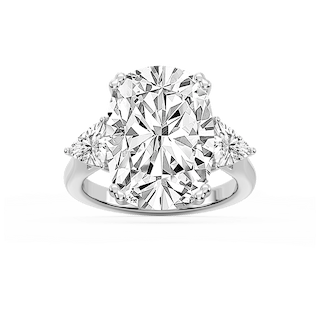
An elongated cushion carries over the same softly rounded corners and pillow-shaped faceting as a traditional cushion, but stretches the proportions into a more rectangular silhouette, typically landing around a 1.15:1 to 1.5:1 length-to-width ratio. The result keeps the cushion's warm, candlelight sparkle while adding the finger-lengthening effect associated with shapes like oval and marquise.
It's a natural pick for anyone drawn to the cushion's romantic, vintage-leaning glow who also wants a stone that reads a little larger and more elongated for its carat weight. As with other rectangular shapes, the corners are best protected with a setting, like a four-prong or halo, that guards the edges from daily wear.
Shop elongated cushion cut engagement rings
Marquise:
The marquise cut is an elongated shape with tapering points at both ends. According to diamond lore, it was first commissioned by King Louis XV of France, who wanted a diamond shaped to echo the smile of his mistress, the Marquise de Pompadour. Traditional length-to-width ratios run from about 1.75 to 2.25.
Because so much of the rough diamond's surface area is preserved in this elongated shape, a marquise tends to look larger per carat than almost any other cut, and its pointed silhouette visually lengthens the finger. As with oval and pear shapes, it can develop a bow-tie effect, and both pointed tips need a protective setting to guard against chipping.
Shop marquise cut engagement rings
Radiant:
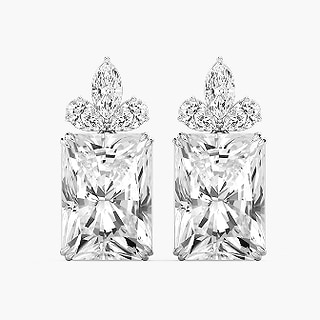
The radiant cut takes the rectangular or square silhouette and blocked corners of an emerald cut and combines them with the triangular, brilliant-style faceting of a round or princess, roughly 70 facets in total. The result is a shape with more fire and sparkle than a true step cut, while keeping the emerald's clean geometric lines.
MiaDonna's radiant is cut to a 1.5:1 length-to-width ratio, so the stone reads rectangular rather than square.
Shop radiant cut engagement rings
Pear:
The pear shape most resembles a ‘teardrop’ with its rounded end on one side and a tapering point at the other. The pear is considered a feminine shape and the more elongated its shape is, the more slender your fingers will appear. Pear shape diamonds can vary in their length and width ratios, with the most common ratios varying between 1.45 and 1.75.
Shop pear cut engagement rings
Princess:
The princess cut is the clean, square counterpart to the round brilliant: sharp, uncut corners and a modified brilliant facet pattern (as many as 76 facets) give it nearly as much fire as a round while reading more modern and geometric. It's been a mainstay fancy shape for decades and remains one of the most requested square silhouettes.
Because its corners are its most exposed point, a princess-cut stone is more vulnerable to chipping than a rounded shape. A setting that shields the corners, like a four-prong head or V-prong, is worth prioritizing if the ring will see daily wear.
Shop princess cut engagement rings
Asscher:
Asscher cut diamonds are simply a variation of the classic emerald cut. Asscher cuts are square in shape and have distinct cut corners, which add to its geometric appeal, making the diamond appear almost octagonal. However, it is the pavilion (bottom part of the diamond) that defines the uniqueness of this shape, which has a "scissor cut" with all facets, step-cut down toward the culet (point on the bottom).
Shop asscher cut engagement rings
Heart:
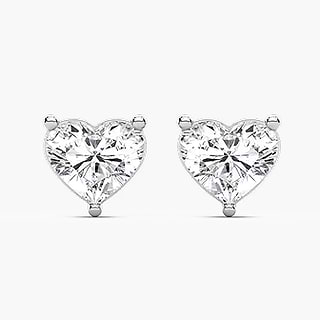
A heart-shaped diamond is a modified brilliant cut built from two rounded lobes divided by a distinct cleft at the top, tapering down to a single point at the bottom, with roughly 59 facets in total. It's widely considered one of the hardest shapes to cut well: the two lobes need to mirror each other exactly, the cleft has to read crisp and even, and the point has to stay sharp without chipping.
Unlike more elongated shapes, a heart is typically cut close to a 1:1 length-to-width ratio so its silhouette reads clearly rather than squat or narrow, which is also why hearts tend to look their best at 0.50 carats and above. Like pear and marquise shapes, hearts can develop a bow-tie shadow across the center, so it's worth viewing the stone in person or on video before choosing one, and a setting with a V-prong at the tip and support across the cleft helps protect its most exposed points for everyday wear.
Shop heart cut engagement rings
Other Fancy Diamond Shapes
Beyond the shapes above, a handful of less common cuts show up most often as accent stones or in vintage-inspired designs:
- Trilliant / Triangle – A triangular brilliant cut with sharp points and bold flashes of light; typically used as a side stone flanking a center diamond.
- Baguette – An elongated rectangular step cut with minimal faceting, most often used as a side stone in Art Deco-style settings.
- Half Moon – A semi-circular step cut, usually paired as side stones alongside an oval or emerald center.
- Kite – A four-sided, diamond-shaped (rhombus) cut, often set as an accent stone in east-west or cluster designs.
- Old European – An antique precursor to the modern round brilliant, with a smaller table and higher crown that produces a warmer, softer sparkle suited to vintage and heirloom-style pieces.
- Old Mine Cut – An antique cushion-shaped cut with a high crown and small table, faceted for candlelight rather than electric light; the direct ancestor of today's cushion cut.
- Trapezoid – A four-sided shape with two parallel sides of unequal length, typically used as a side stone alongside a center diamond.

